home: noun
A magnolia tree at the Beecher Terrace public-housing complex came to represent so much for generations of residents who lived there. What does it mean when a tree like that comes down?
BY NIKAYLA EDMONDSON-EZELL
PHOTOS BY ERIK BRANCH
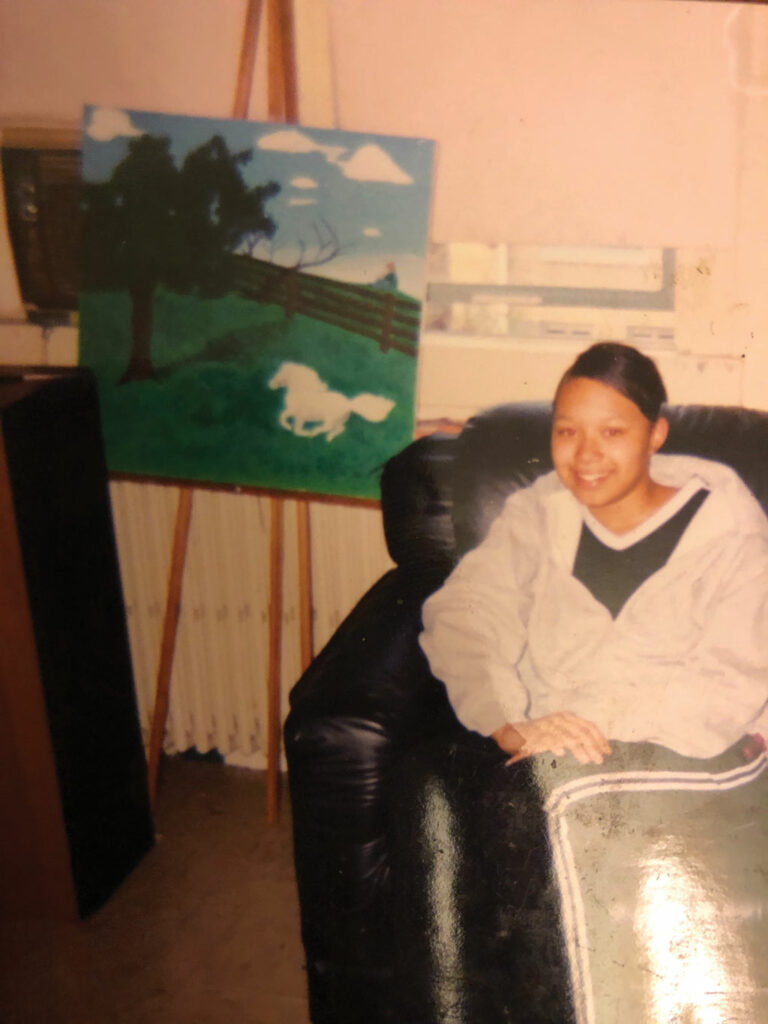
My first home was in Park Hill, 1994, in the Algonquin neighborhood in west Louisville. My mom moved herself and my two older sisters there from Cotter Homes before getting pregnant with me. From one housing project to another. I was a little girl in this apartment, lived there up until I was probably not even four years old, but I remember it. The cold concrete steps, the orange gloom of the streetlights glowing through the window. It’s where I have a memory of first seeing my mother’s painting of the old magnolia tree at the Beecher Terrace public-housing complex.
On the canvas, she depicted endless blue sky, fresh grass and a lush-maned white horse galloping past a detailed magnolia tree with deep-green leaves. The easel displaying the utopic painting stood next to a deteriorating black leather couch and almost seemed backlit by the streetlight. Something about the imagery always felt so surreal to me because it was nothing I had seen growing up in the projects. It was almost make-believe.
More than 25 years later, in early 2017, my mom called me after learning that Beecher Terrace would be razed as part of a $200-plus-million revitalization project known as Vision Russell.
She said to me, “I need to save the tree.”
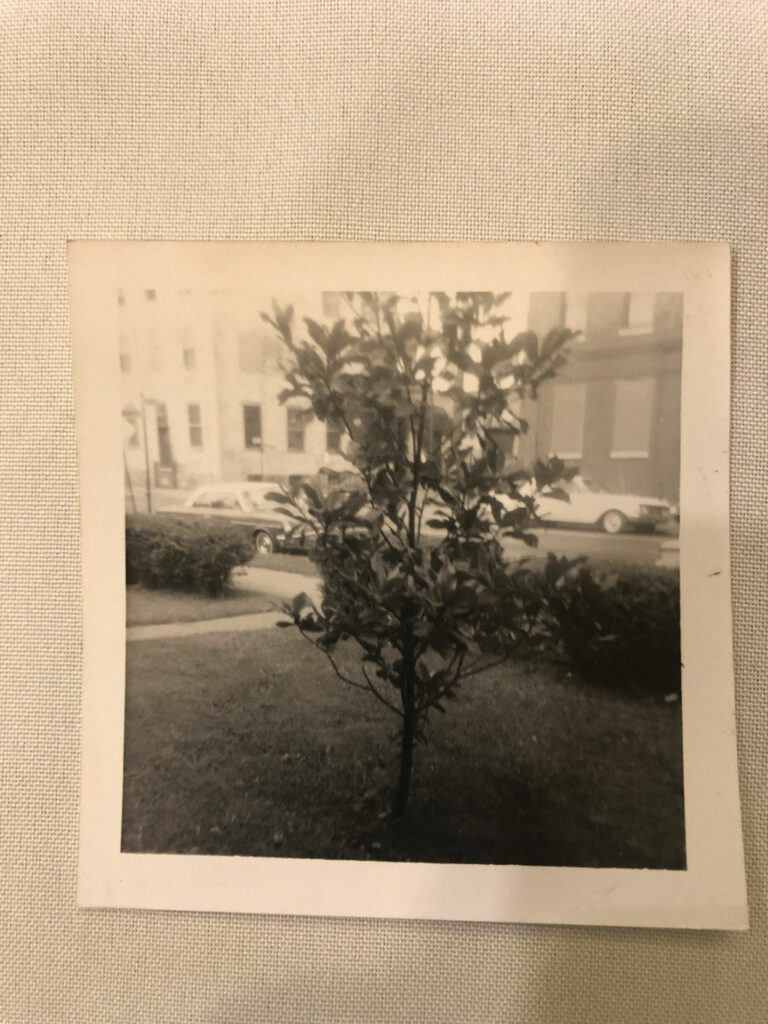
My grandmother, my mom’s mom, was an activist in Louisville in the 1970s, and whenever my grandmother was busy, Mattie “DeeDee” Brown would babysit my mom. Miss DeeDee, born in 1904, had a son later in life named Clarence Johnson. He went to Wheatley Elementary, in the California neighborhood in west Louisville, and one day around 1950, when he was in kindergarten or first grade, he brought home a young but maturing magnolia tree from school. He planted it in front of their one-bedroom apartment in Beecher Terrace, the first building of which was constructed in 1939. (Beecher Terrace eventually occupied 30-plus acres west of downtown in the Russell neighborhood, bounded by Muhammad Ali Boulevard and Jefferson, Ninth and 12th streets).
Miss DeeDee, my mom said, “was like a good, big mama.” She had a happy, high-pitched voice, and she’d yell through the screen door at my mom or any other kids trying to climb the magnolia’s trunk and branches. “Don’t touch that tree!” she’d yell. “Get off the damn tree!” And they’d get off the damn tree.
The tree instilled in my mom an adamancy to create a safe life for us, to do her best to provide the conditions so we could grow, no matter how uncomfortable life became.”
“It’s very fragile,” Miss DeeDee would say. “You have to give it time to grow.”
Clarence went to Central High School, then to war in Vietnam before making his way back to Louisville. His daughter, Marcelle, recalls summers spent at Beecher Terrace and spending time at the community center there. She and her brother, Corey, pulled a wagon to get groceries at nearby Village West. “I hate that a lot of deaths happened in Beecher Terrace,” Marchelle said. “We are so recyclable, and we tend to look at life like, ‘Oh, well, he got killed,’ and keep on moving. The mindset of children now is totally different. We lived for life when we were kids. When we were 14, we weren’t thinking about fighting or gangs and none of that. We were kids.”
Their grandmother’s place, she said, “always felt much bigger than what it really was. It would usually be four or five of us playing in there, this tiny one-bedroom apartment, but it felt so big.” Marcelle remembers her grandmother’s voice, same way my mom does. “Can’t help but think about how much my grandmother loved that tree and protected that tree,” Marcelle said, “because she put so much work into making sure it would become this large, living thing.”
Laura Johnson, Clarence’s second wife for over 20 years, recalls how, in her husband’s later years, he would say, “‘Oh, I never realized how much work it was to grow that big old tree.” When they watched HGTV, he would say, “My tree had curb appeal.”
Mr. Clarence died in 2017, around the same time my mom heard about the Beecher Terrace construction project. Laura Johnson said, “A couple months before he died, we were going somewhere, and I said, ‘Why don’t we stop and take a picture of you in front of the tree?’ And he said, ‘Oh, no, get it another time.’ And then another time never happened.”
Trees are living things, but what if they were beings? Imagine all the things their eyes could see, all the things their ears could hear, all the stories they’d be able to tell about the storms they’ve weathered.
When I think about the magnolia tree, when I think of my mom’s fondness for — her borderline obsession with — that tree on Ninth Street, it can seem like the tree itself was her home once. In a way, it was. “That tree,” she said, “was like a source of protection for me, that safe haven.”
I think about the homes I’ve lived in, the homes I’ve lived out of. All the places my mother borrowed so we’d have a roof over our head. All of Louisville has been my home, from the arguably richest ZIP codes to the considerably poorest. From a three-story home to a one-bedroom shotgun to a “studio,” if you count the month we lived in a hotel room.
“Moving forward, trying to move forward, with my life and with my children, you have to sometimes look back in the past to see how I got to where I was at that moment in my life,”
my mom said. “I started looking back, thinking about my childhood, maybe some of the trauma.”
My mom, Rachel, was born in 1972. (People always ask why I call my mom Rachel. When my older sister was two, she started calling our mom Rachel, so that’s what I did after I was born.) She lived at Beecher Terrace. Then, in 1974, the family — my mom, her sister, Rachelle Luretta Alexander Edmondson, and their mother, Rachelle Alexander Edmondson — moved to Herman Street in west Louisville. My mom went into foster care in 1985 because of her mother’s alcoholism. The state granted temporary care of my mom to a family friend, the thought being that my mom would eventually be taken into custody by her sister, Rachelle, who had just turned 18 and was staying with an older cousin while attending U of L as a freshman. Her mother died before all of that could happen. My mom said the woman who’d taken her in decided she couldn’t afford to care for her “the week Mama died.”
She was placed at West Market and 40-something streets. “I remember the lady wouldn’t let me control the shower,” she said, “so I’d wash up with the soap and she’d turn the shower on and off for me in between.” All she remembers about the second foster home was that it was far out, with a woman named Ms. White. “I had all Mama’s stuff and was looking at her pictures, and Ms. White told me, ‘You just have to get over it,’” my mom says. “She had to hold me and calm me down. Mama had just died a week or so before.” My mom got pregnant (with my sister, Timmy) while living on Osage Avenue near Victory Park, where she lived with a woman she came to know as Mom Becky until she aged out at 18, then moved again, then came back. “Sometimes,” she said, “I’d sleep outside.”
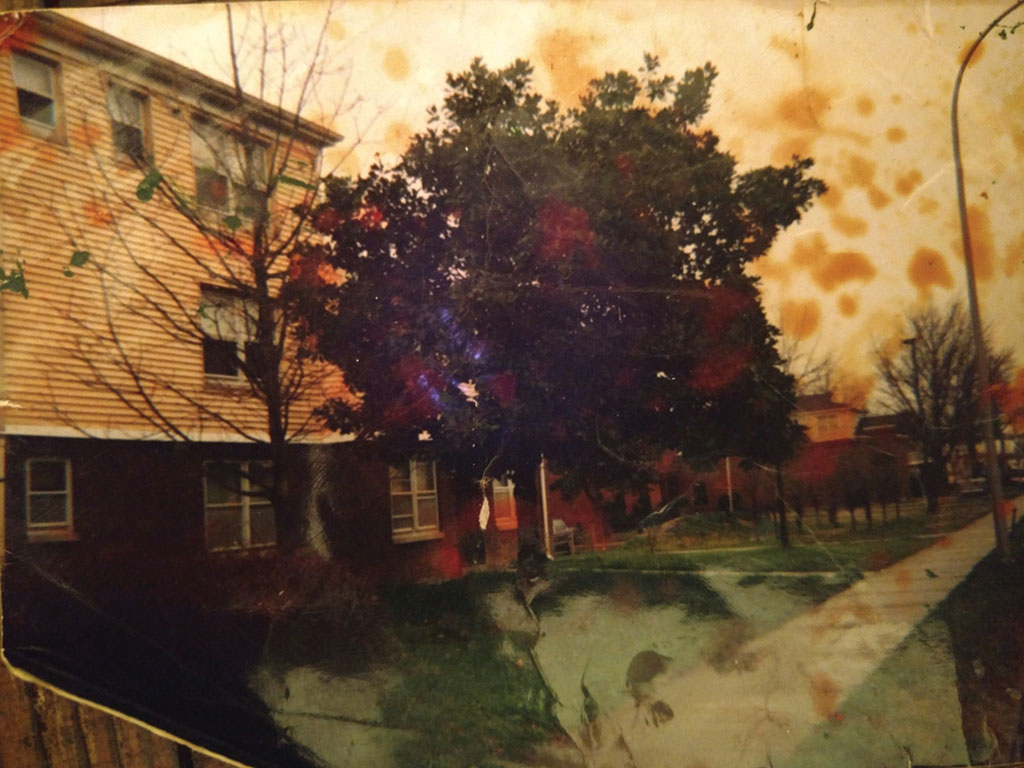
When she got pregnant again (my sister, Erica), she moved into Cotter Homes. When she got pregnant with me, we moved to Park Hill, the one with the cold concrete floor, the one where I formed my first memory of her version of the magnolia. She’d painted it for an art class she was in, the assignment being to find something significant from childhood to put on canvas. She took a picture of the magnolia in 1996, based her painting off that. The painting followed us from place to place.
What I remember about our second home, on Beech Street in west Louisville, was that I’m pretty sure this was where we got our first white German shepherd, Smokey, and where, for my fifth birthday, I received my first five-dollar bill. It was here where I had my first confrontational argument, telling my neighbor I’d get my mom to fight hers, my sister to fight hers, and that my other sister and I would fight her. My mom called me inside. We had a glass table that I remember breaking, throwing a tantrum.
My third home, on West Kentucky Street, was our first house (not an apartment), right across the street from Victory Park and around the corner from all my play cousins. My mom worked as an assistant at a construction site and started working on her bachelor’s degree. One day, we came home and everything was gone. Robbed. Everything but a futon, gone. My cousin Buddy came to stay with us here. He was a teenager and an athlete at Manual High School. He used to trap me in the laundry basket and roll me down the stairs. Once, a squirrel got stuck inside the house on the second floor. My mom wasn’t home. I don’t remember how we ever got it back outside.
Eventually, my Aunt Shirley told my mom, “Rachel, you got to get them out of there.” My mom said, “I saw how dangerous some of those guys who lived there really were, all the killings and all that stuff, but y’all never really had to see it, per se. One got killed, a couple more people got killed, then there was the one who got killed on the corner. We did see that. That was it for me.” For that last one, the one on the corner, I remember getting off the school bus and seeing the scene taped off. I don’t remember being outside much after that.
We moved farther out to an apartment. Buddy stayed with us more, visited frequently. I remember he took his girlfriend (now- wife) Jutta to prom. I had my first opportunity to skip a grade, but I wasn’t emotionally mature, so my mom decided to keep me put. I told everyone Santa was fake.
I remember the hotel because Smokey wasn’t allowed in, but we brought him anyway. “He never barked or nothing,” my mom said. “Smokey was the smartest dog.” We never seemed to have food, but we were also never hungry, often going to the B&E Salvage Grocery.
Girard Drive in the Lyndon area was my introduction to the suburbs, my first real look outside the projects. Third through sixth grades, the longest I’d lived anywhere. I started competitive cheerleading here. The funhouse, the fight club. Constantly filled with people, but I was still somehow lonely. I met my biological father here for the first time, didn’t see him again until I was 17. My sisters were supposed to be in high school, but they had dropped out or my mom had let them discontinue. It smelled like dogs, puberty and the road to freedom. This was the true beginning of the struggle.
During this time, Aunt Shirley, Cousin Buddy’s mom, was killed. Closest thing to a mother that my mother had known. I can remember the fury from my family in this home on the day Aunt Shirley died, but also the love. Sadness is weird that way. During this time, I also made my last visit to Uncle Reece’s home in Beecher Terrace. His children were moving him to a nursing home. Had it been up to him, he would’ve stayed at Beecher Terrace until he died. He always sat on his peeling camel- colored leather loveseat in front of his brown-boxed, black-and- white TV, in the room with his 365-days-a-year Christmas tree. Uncle Reece was brown-skinned, with crinkled gray hairs in his nose and ears. He babysat us often when my mom was in evening classes. Over the years, I wonder how many times she visited the magnolia when she went to see Uncle Reece.
We moved back to my mom’s childhood home, seven of us in a two-bedroom shotgun at 34th and Herman streets. Back to the ’hood. But it was a roof.
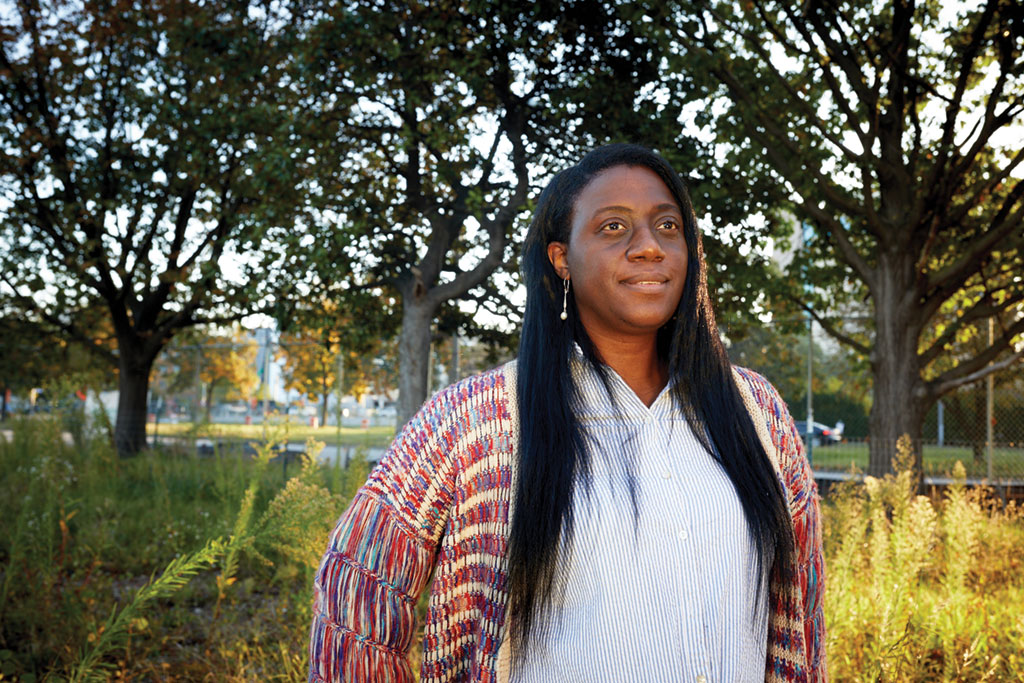
The author's mother.
Cypress Street, our eighth home. One day, I walked across the street while on the phone right before the house was shot up. No one was home. I casually called my mom.
We moved to Millers Lane in Valley Station, another attempt to escape the trauma. We took in my great-grandmother. This is when another family member began a battle with addiction. “Doing drugs while y’all were in there,” my mom said. We watched my mother and this family member physically fight.
By the time we moved to River Road, I was a sophomore in high school. It was a five-bedroom home, and we all had our own room, though my oldest sister no longer lived with us. I fought with my mom a lot here and, for the most part, chose instead to live out of my older sister’s apartment.
The last home I lived in with my mom was in south Louisville, a street called Windsor Forest Drive. She said, “I felt like I’d solidified somewhere, where it was like, ‘OK, this is the house. This is going to be the family house where, no matter what happens to me, the family will always have somewhere to go.’”
Windsor Forest had big windows that peered onto the porch. My great-grandmother, who lived with her, was in her mid-90s. My mom wanted her “to be somewhere where she could spend her final days.” They enjoyed watching sunsets together. “Simple things,” my mom said. “Walking into the kitchen to get coffee.”
Eventually, she needed to pack up, move again.
Somewhere along the way, my mom lost the painting, possibly in a storage unit. Now, all she has is a photo of the photo she used as a reference.
We all want to be proud of where we live,” my mom said, “have something that’s connected to nature.”
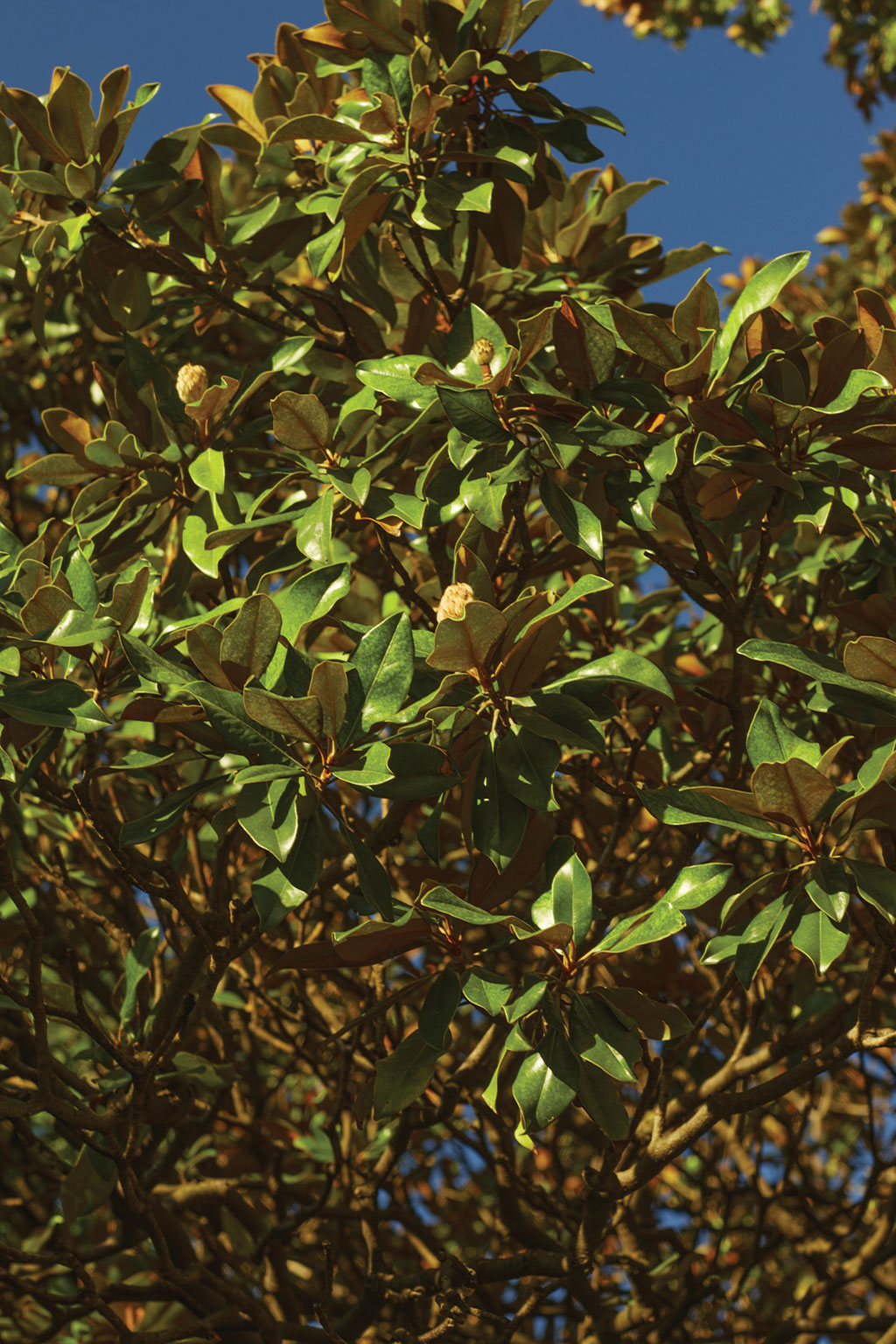
In 2017, when my mom heard about the Beecher Terrace demolition plan (and while I feared gentrification in the Russell neighborhood), she fixated on saving the magnolia. When she learned that several trees, including the magnolia, would need to go to make room for the new construction, she got back in touch with her contacts at the Louisville Metro Housing Authority, which oversees public housing in our city. “I want the wood from the tree,” my mom said. “I want the seeds from the tree.” She would’ve taken the whole thing if she could’ve.
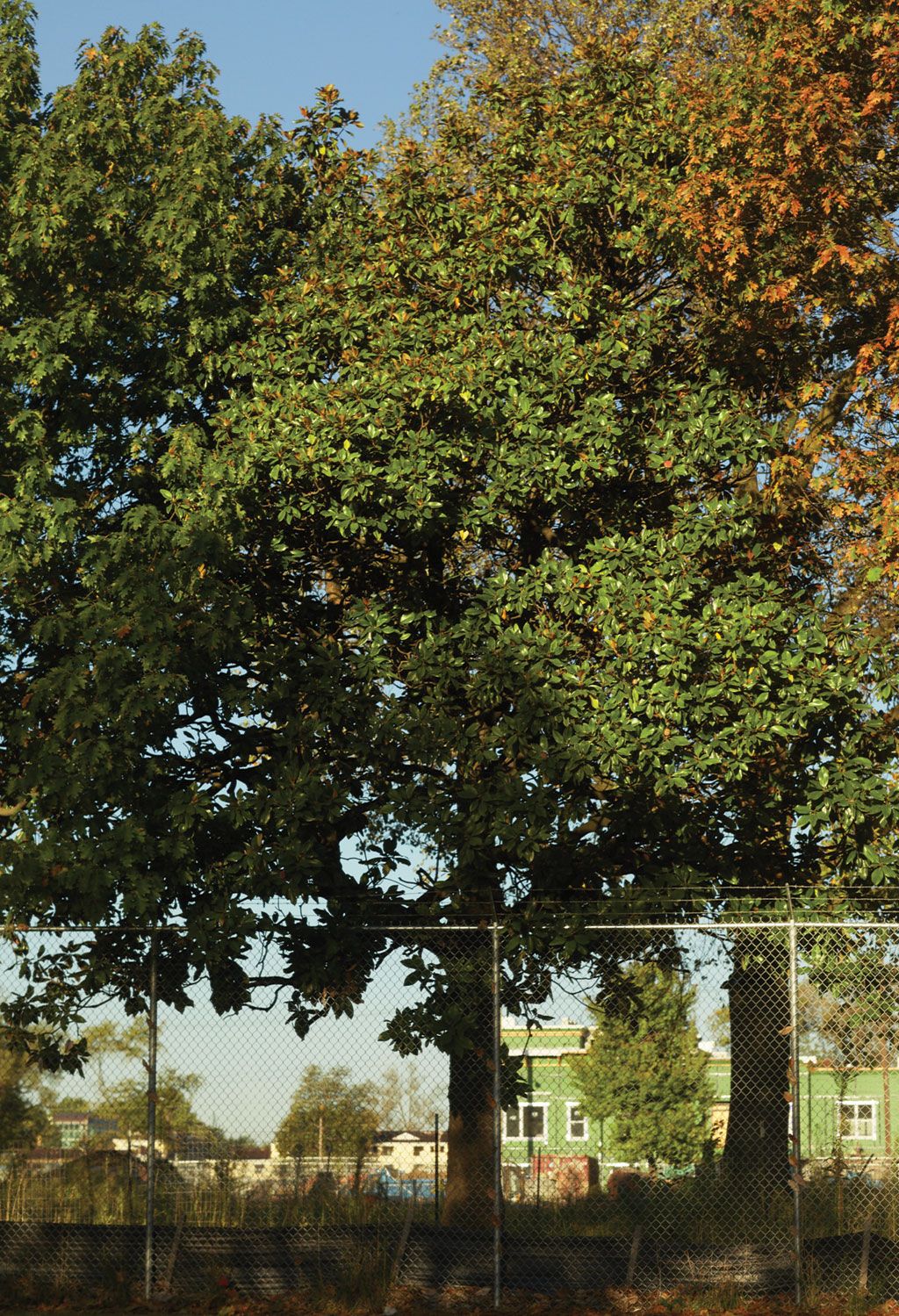
At 7:30 in the morning, on Oct. 12, 2020, we arrived at the job site to meet with the superintendent and a man from Kentucky Tree Service. “Big part of my childhood,” my mom said. “I’m trying not to cry.”
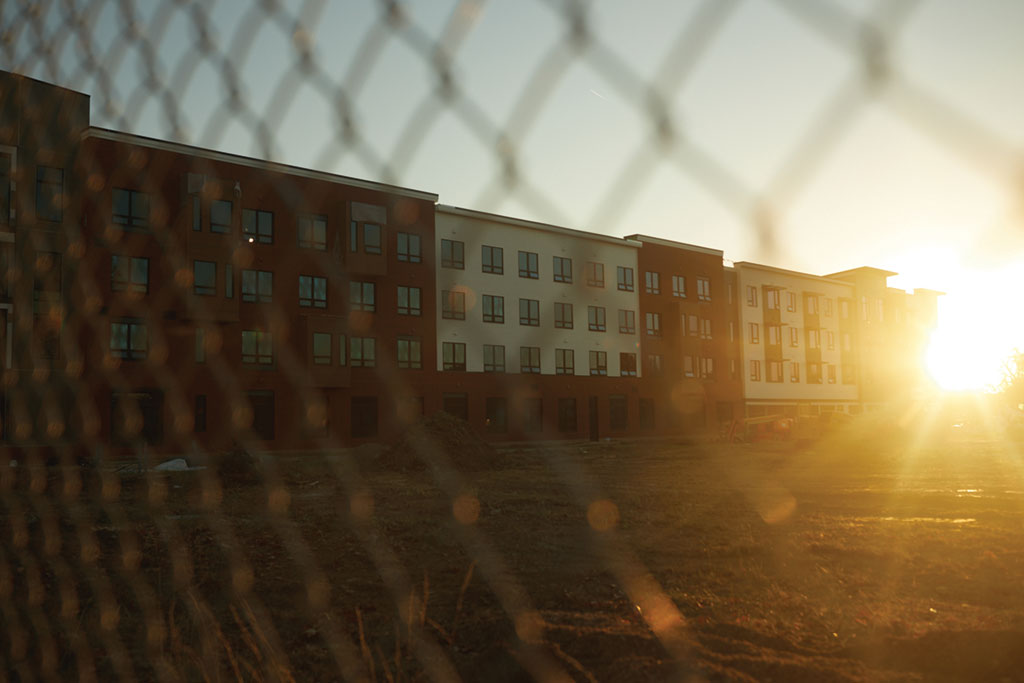
We walked around the fence to where the apartments used to be. Clarence Johnson’s son, Corey, was there too, and, from memory, he and my mom tried to reconstruct the Beecher Terrace of their youth, pointing out who played where, who sat where outside, where everyone in the building used to live. Corey had just gotten off the phone with his sister, Marcelle. “She was getting emotional,” Corey said. He was too. “I’ve just always been used to seeing it right here,” he said. “I took my past girlfriends to see the tree. We’d stop over, and it was a part of the date, like, ‘Look here, my daddy planted this.’”
Corey went on: “He planted it for his mom. That was it. A project at school.”
Clarence simply brought home roots that his mother nourished, roots his children cherished until the last moments. The tree instilled in my mom an adamancy to create a safe life for us, to do her best to provide the conditions so we could grow, no matter how uncomfortable life became.
At the site, my mom said, “I thought that I would always see this tree. Up into my old age.”
It was becoming harder for them to hold back tears. “Even though it’s a sad ending — because I know the story of this tree and was expecting for this tree to stand beyond my lifetime — it’s going to be somebody else’s new beginning,” my mom said.
That day, my mom would take the eight-foot pieces of wood from the magnolia to a mill in Indiana, to be cut up further and cured. “Plenty of things we can do with what’s left of the tree,” she said. Her plan: turn it into furniture, jewelry boxes, trinkets, walking sticks. For us and for Clarence’s children and grandchildren and great-grandchildren. “So even though the tree’s going to be killed,” my mom said, “in a way it will still be alive.”
The best estimate is that Clarence Johnson planted the magnolia in 1950. It stood for 70 years.
Seventy years, down in seven minutes.
While writing this piece, I have constantly asked myself about the significance of the magnolia to me. It was a part of my childhood too. Not the physical tree, exactly, but my mother’s painting of it. The dream, if you will. The fantasy outside the struggle.
I realize now that home can be a place and also a state of being. You’re your home.
There was a time in my life when I remember never wanting, never feeling a need, to own a home, to be married, to have kids.
I moved away from Louisville last year and am living in a sunny third-floor apartment with my husband and two daughters, Ava, who is eight, and Lyla, who is five. Our favorite space in our home is probably our light-drenched living room. It is 50 percent windows, 25 percent bookshelves, so we have lots of plants and books.
I want to be able to give my mom the physical home she always provided for us. And I want for her what she wanted for us: a home to always come back to, where we’ll always know we are safe and together. A space for her to grow her trees and know that they’ll never be uprooted.
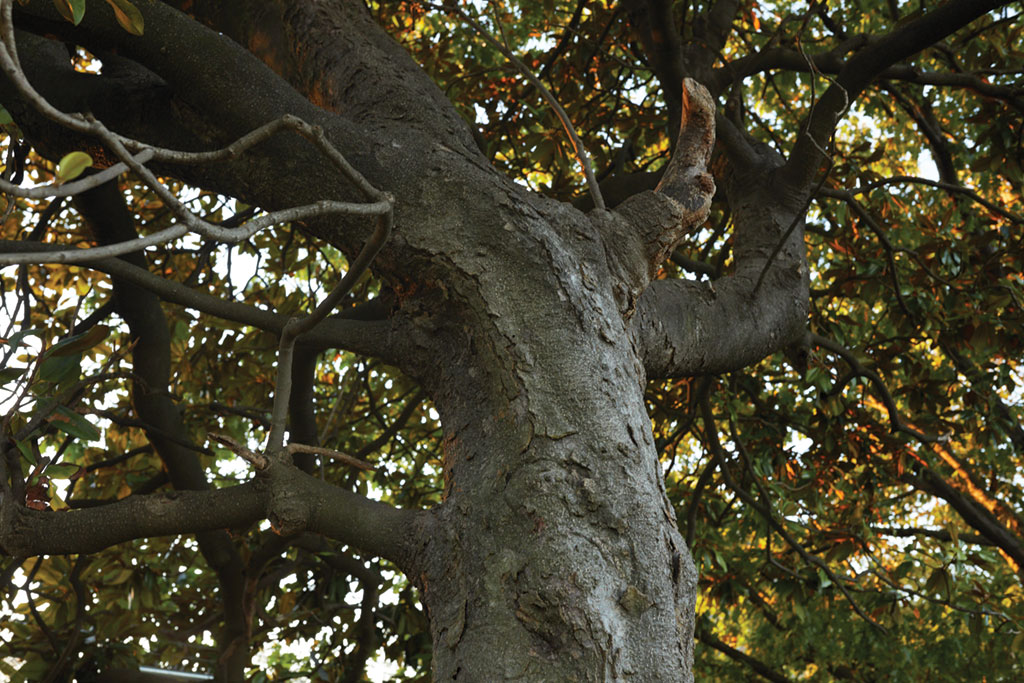
The magnolia’s stump, with a circumference of probably 15 feet, has been sliced and treated. Our first big project will be to make an epoxy coffee table we designed together. With the largest piece of the magnolia, we’d eventually like to make a dining room table that sits all nine of us: my mom, her four kids, her three grandkids and my husband.
My mom lives in Louisville surrounded by plants. One room, literally, is nothing but plants. Her apartment is like a greenhouse. In the end, she collected 10 magnolia seeds and 30 acorns from the 200-year-old oak that stood nearby and also came down. Almost two years later, two oak trees are about 18 inches tall, no more than two centimeters thick. Still very small, but growing.